
Let's Take the Red Pill
The Glitch, Power, and the Great Remembering

The other day a friend asked me whether it was true that Ring shares footage with ICE. She wants to install a camera at her front door and, knowing how I pay close attention to the news cycle, wanted my take.
I didn’t know the answer. What I did know was that I already have a Ring camera.
For years it turns out, I’ve been inviting surveillance into my life in small, reasonable-sounding increments. It started with a fingerprint on my phone, then Face ID. Now a camera sits at my front gate, a small plastic sentinel mounted there by my husband. I told myself it was for convenience and safety. Packages, visitors, the ability to see who’s there without needing to go outside to unlock the gate.
But as I sat with my friend’s question, the aperture widened. I saw myself—as many of us are—like a character in The Matrix who chose the blue pill without realizing it: willingly plugged into a system I didn’t build and don’t control.
This is the shape of power today. Not just the blunt “power over” of the State, but the softer, more seductive power of convenience—the power we hand to tech companies, the reverence we bestow on billionaires, the quiet way we consent to being watched because it makes our lives a little easier.
We’ve traded friction for a feeling of safety. And in doing so, we’ve traded away something else: agency.
Aldous Huxley understood this. Of all the mid-20th century dystopias—1984, Fahrenheit 451, Brave New World—it’s Huxley’s book that feels closest to where we’ve landed. Not a boot stamping on a human face, although that’s now happening too, but a population lulled into compliance by comfort, entertainment, and ease. We didn’t get forced into the cage; we walked in, sat down, and connected to the Wi-Fi.
We are living through the final, comfortable stage of a civilization paradigm where frictionless living is the highest good. Power over has learned to wear a friendly face.
The Theology of Wealth
If surveillance is one face of modern power, wealth is another. To understand the world we’ve created, we have to look at the math of our devotion.
We speak of billionaires with a kind of awe, as if they occupy a different category of human; almost a superior species. The scale of what we’re revering is hard to grasp, so we rarely try. Consider this: ”If you earned $1 every second, you would reach $1 million in 11 days. To reach $1 billion, you would need 31.7 years. If you earn $100,000 a year, it takes a decade to see a million; it would take 10,000 years of work to earn a billion. If you spend $1,000 a day, it would take you just 2.7 years to spend a million dollars. If you spent the same amount a day, it would take you 2,740 years to spend $1 billion.”[1]
This is a level of wealth that cannot be ethically made or meaningfully spent in a thousand lifetimes. And yet many of the systems that shape our days now orbit these figures. Musk, Bezos, Zuckerberg: people who began as “disruptors” and have quietly become state-adjacent institutions, providing infrastructure for everything from communication to space launches to neighborhood surveillance.
We talk about them as innovators. In practice, they function like digital feudal lords, owning the platforms where we speak, the clouds where our memories live, the networks through which our daily lives move. Our fingerprints, our faces, our front doors are all data points in an empire built on the idea that more is always better—and that those who have the most deserve the power that follows.
We don’t just tolerate this arrangement. We mythologize it. We treat staggering wealth as proof of superior intelligence or virtue. We let it stand in for God.
When the numbers get this large, we’ve left the realm of economics and entered something closer to theology.
The Epstein Files and the Architecture of Power
Every so often, a glitch appears in the Matrix—one of those moments when the curtain lifts and the architecture of power becomes visible.
The recent unsealing of documents related to Jeffrey Epstein is one of those glitches. It’s tempting to file the story under “individual depravity,” to focus on the salacious details and move on. But if we’re willing to look critically, a different pattern emerges.
The guest lists and flight logs cross every political and ideological boundary. Left, right, royalty, finance, academia, entertainment—the whole spectrum collapses into a single picture: a protected circle of people whose money and status has insulated them from consequences.
This is what a State–Corporate Hybrid looks like in practice. It is not loyal to a party or a platform. It is loyal to power itself. And when power over becomes the organizing principle, moral lines blur. Harm is tolerated, even organized around, as long as the hierarchy remains intact.
For many, those files are a “red pill” moment. The comfortable belief that “our side” holds the moral high ground starts to crack. We begin to see that the issue is not just which team is in charge, but the game itself.
The Glitch in Human Time
Here’s where my own theory comes in.
I believe the last 6,000 years of human history—the era of kings and empires, god-ordained rulers, and extractive economies—is a glitch in our evolution.
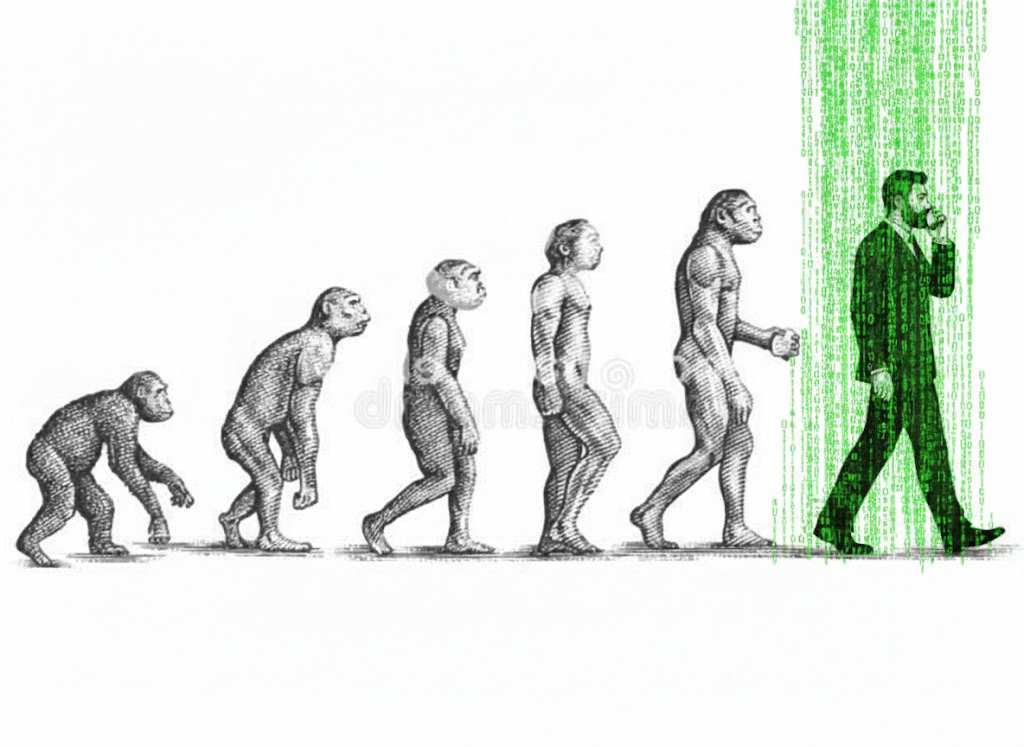
Homo sapiens have been around for roughly 300,000 years. For most of that time, our ancestors lived in small, mobile, fiercely egalitarian bands. Anthropologists describe what’s called a “reverse dominance hierarchy”: if someone tried to act like a tyrant or god-king, they were mocked, shamed, or pushed out. The group protected itself from narcissistic power grabs because survival depended on cooperation.
Imagine dropping a modern billionaire with his private rocket and compound into one of those early human camps. He wouldn’t be revered; he’d be laughed at—or feared and sent away, maybe even killed.
If we had behaved for the last 300,000 years the way we’ve behaved in the last few millennia—hoarding, conquering, extracting at all costs—we would have died out long ago, like so many other hominid species. Instead, something particular to the Holocene happened: a relatively stable climate allowed agriculture, which allowed surplus, which allowed a very specific experiment in hierarchy to take root.
That experiment is what I’m calling the Glitch.
The Glitch is the belief in power over: over each other, over other species, over the Earth itself. It’s the story that says humans stand outside the web of life, that we are the owners and managers of a five-billion-year-old sentient planet rather than one humble strand in its fabric.
In deep time, the “Human Era” will appear in the fossil record as a thin, strange layer of plastic and carbon—a “fever spike” the planet eventually broke. Humans are a mere 0.007 percent of Earth’s timeline. To imagine that this brief experiment in hierarchy is the pinnacle of evolution is not just arrogant; it’s biologically absurd.
We are trying to fix a biological crisis with technological fixes, without questioning the underlying story of power that created the crisis to begin with. That’s the Glitch thinking: more control, more data, more growth, more, more, more.
The Earth is not negotiating with us.
The Great Reordering—and the Great Remembering
The environmental collapse we see on the horizon is not a punishment from an angry planet. It is the natural consequence of a system that believed itself separate from the laws that govern every other form of life.
You could call what’s coming the Great Reordering. The frictionless era is ending. The external costs we pushed into the atmosphere, the oceans, and the bodies of the vulnerable are circling back. The train we set on the tracks of infinite growth is entering terrain where those tracks no longer exist.
This is terrifying, especially for those most dependent on the current arrangement—those whose power is measured in stock prices, satellites, and fortified compounds. The billionaires are fighting a losing battle against a living world that does not recognize their spreadsheets as reality.
But collapse is not only an ending. It is also an opening. If the Glitch was a 6,000-year illusion of power over, then what waits on the other side is not a blank void. It is something far older: the memory of power with.
This is what I mean by the Great Remembering.
The Great Remembering is the recognition that we are animals again—still, always. It’s the return to the knowledge that our well-being depends on the well-being of the soil, the water, the pollinators, the people next door. It is an invitation back into relationship, after a long season of conquest.
In practical terms, it looks surprisingly simple. It looks like learning the name of your watershed and treating it as kin. It looks like growing food in whatever patch of earth or pot of soil you have and sharing the harvest with neighbors. It looks like mutual aid networks that step in when the market and the state fail—people organizing rides, childcare, groceries, generators, not because an app told them to, but because they recognize one another as part of the same body.
It looks like communities making decisions in circles again, not just waiting for orders from distant institutions that see them as data points and consumers. It looks like measuring a “good life” not by how much we can accumulate, but by how deeply we are woven into the web of care.
At its heart, the methodology of the Great Remembering is ancient:
Take only what you need, not more. Seek ways to give back and be of service. These are not slogans; they are survival strategies for living on a finite, sentient planet.
Taking the Red Pill
So what do I tell my friend about Ring?
I can send her the articles about data-sharing agreements and police partnerships. I can talk about ICE and Flock and the risks of normalizing cameras at every entrance. But beneath all of that is a deeper question:
Which story of power are we choosing to live inside?
We may not be able to opt out of the Matrix entirely. Most of us still carry smartphones, still engage with the systems we critique. The point is not purity. The point is awareness—and the choices that awareness makes possible.
Taking the red pill, in this context, means seeing the Glitch for what it is: a brief, dangerous experiment in power over. It means noticing how much of our fear and behavior has been shaped by the theology of wealth, the worship of convenience, and the myth that someone else—some billionaire, some platform, some government—will keep us safe if we just hand them enough control.
It also means remembering that another way of being human is not only possible, but older than the Glitch itself.
The Great Remembering is not a nostalgic fantasy of going “back” to some pristine past. It is a forward-facing choice to root our future in different assumptions: that life is relational, not transactional; that power is something we share, not something we wield over one another; that the Earth is not our property, but our elder.
We are living through the end of one story. We can’t stop that. But we can decide what we plant in the soil of whatever comes next.
And that, more than any camera or algorithm, is where our real power lies.
[1] Amanda Doyle We Can do Hard Things
