
Recognizing An Ending
The Bronze Age Collapse and the First Mirror of Our Own Moment

Around 1300 BCE, a merchant vessel sank off the southern coast of what is now Turkey, near a place called Uluburun. It lay on the seafloor for three thousand years before divers discovered it in 1982.
What they found was a world in miniature.
The ship’s cargo hold contained copper and tin ingots, ebony logs, glass, ivory, exotic spices, Egyptian jewelry, Canaanite jewelry, Mycenaean pottery, a Mycenaean sword, a Babylonian cylinder seal, and goods traceable to at least seven distinct cultures spanning the entire Eastern Mediterranean. A single trading vessel, moving through a single sea, carrying the material threads of a civilization so interconnected it would not look out of place in a contemporary account of globalization.
This was the Late Bronze Age at its apex. And within a hundred years of that ship’s final voyage, almost everything it represented would be gone. Completely wiped off the map.
The World That Was
To understand what collapsed, you have to first understand what existed — because the Bronze Age Mediterranean world was far more sophisticated and far more interconnected than the history most of us were taught.
The great powers of the era — New Kingdom Egypt, the Hittite Empire of Anatolia, Mycenaean Greece, the city-states of the Levantine coast — were not isolated kingdoms. They were nodes in a system. They traded continuously across vast distances. They wrote to each other in a shared diplomatic language. Their kings called each other “Brother.” They maintained fixed exchange rates for gold and silver. They sent emergency grain shipments to one another in times of shortage.
The city of Ugarit, on the Syrian coast, was perhaps the most cosmopolitan place on earth. Its merchants operated in multiple languages simultaneously. Its archives contained texts in Ugaritic, Akkadian, Hurrian, and Egyptian. It sat at the intersection of trade routes connecting the Aegean to Mesopotamia, Egypt to Anatolia, and the Mediterranean world to the resources of the interior. A merchant in Ugarit in 1250 BCE inhabited a genuinely global civilization.
The palace economies that managed this world were extraordinarily complex. Mycenaean Linear B tablets — the earliest written Greek — record thousands of individual craftspeople, land holdings, livestock numbers, and trade obligations in meticulous bureaucratic detail. These were not simple societies. They were optimized systems, elaborately interlocked, running on the surplus that a favorable climate had made possible.
They were also, without knowing it, running on borrowed time.
The Great Mystery
Within the span of roughly fifty years — between approximately 1200 and 1150 BCE — almost all of it collapsed.
The Hittite Empire, which had negotiated as an equal with Egypt and dominated Anatolia for centuries, ceased to exist. Its capital Hattusa was burned and abandoned. The royal line vanishes from the record entirely.
Mycenaean Greece collapsed. The palace centers at Mycenae, Tiryns, and Pylos were destroyed or abandoned. Linear B disappeared completely — not simplified, not replaced, simply gone. Greece entered what scholars call a Dark Age lasting roughly four hundred years, during which population declined sharply, long-distance trade effectively stopped, and the sophisticated palace economy that had sustained it was forgotten so thoroughly that when Homer later sang of Agamemnon and Achilles, he was reaching back across a rupture so complete it had become myth.
Ugarit was destroyed around 1185 BCE and never rebuilt. The Levantine coast was swept by destruction. Egypt survived but was permanently diminished, never again achieving the imperial reach it had held at its height.
The destruction was so widespread and so synchronous that archaeologists gave it a name: the destruction horizon. A burn layer visible in the soil across the entire region, dated to the same narrow window of time.
What caused it?
For much of modern scholarship, the answer seemed to stand in the Egyptian records themselves: the Sea Peoples.
The Mystery of the Sea Peoples
They appear in the inscriptions and reliefs of Ramesses III, carved into the walls of his mortuary temple at Medinet Habu around 1177 BCE. The texts describe waves of peoples coming from the north and west, destroying everything in their path — the Hittites, Cyprus, the cities of the Levantine coast — before finally being turned back at Egypt’s borders by Ramesses himself in battles on land and sea.
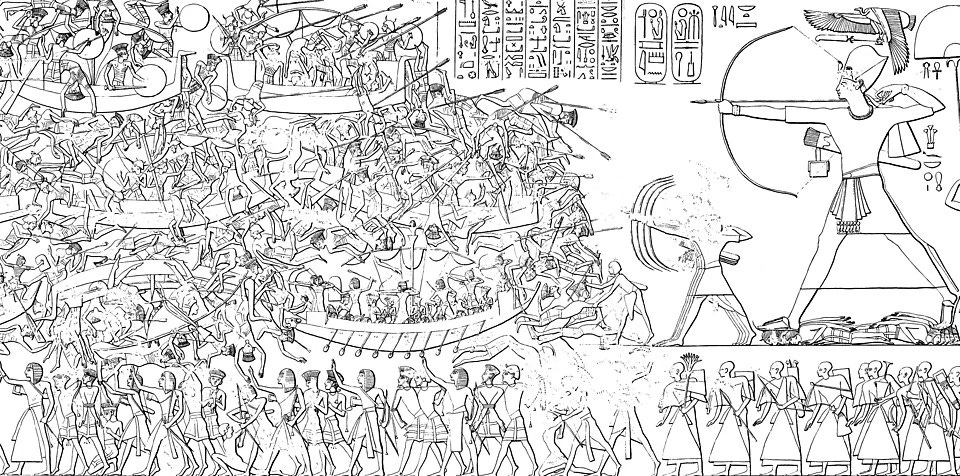
The Egyptian sources name several groups among them: the Peleset, the Tjeker, the Shekelesh, the Denyen, and the Weshesh. They are depicted in the reliefs with distinctive clothing, weapons, and horned helmets. They are described as an overwhelming force that swept through the known world like a tide.
For generations, this was the explanation. The Sea Peoples were the destroyers. The mystery was only who they were — where they came from, what civilization they belonged to, and why they appeared with such sudden and devastating force at this particular moment.
Scholarly attempts to identify them multiplied. The Peleset were generally linked to the Philistines of the Bible, who settle the Canaanite coast after the Egyptian campaigns — a connection strengthened in 2019 when DNA analysis of Philistine cemetery sites confirmed European ancestry consistent with Aegean origins. The Denyen may be Homer’s Danaans, another name for the Greeks. The Sherden had served as elite mercenaries in Ramesses II’s own army before appearing among the invaders. Other identifications remain contested.
But identification was never really the deepest question. The deeper question was causation: why did these peoples appear when they did, in the numbers they did, and where did they come from? Why did a world that had been stable and prosperous for centuries suddenly produce a wave of displaced, seaborne peoples powerful enough to bring down empires in a mere fifty years?
That question remained inadequately answered for a long time. Then paleoclimatology changed the story entirely.
What the Earth Recorded
Pollen cores from the Sea of Galilee. Oxygen isotope analysis from stalagmites in Soreq Cave in Israel. Sediment samples from the seafloor of the Eastern Mediterranean. These are not dramatic sources. They are patient, cumulative, and extraordinarily revealing.
What they show, with increasing precision as the data has accumulated over the past two decades, is a severe and prolonged drought that struck the Eastern Mediterranean and extended across the Aegean into the Balkans and likely further west beginning around 1250 BCE and persisting for two centuries or more. Rainfall dropped by an estimated twenty-five to thirty percent across the region. The pollen record shows Mediterranean trees — oak, pine, and olive — declining sharply while desert scrub expanded. The isotope record shows the drought’s onset, its peak severity, and its long persistence with a clarity that textual sources cannot provide.
The timing is not coincidental. The drought begins precisely when the first signs of stress appear in the Bronze Age system, roughly fifty years before the final collapse. Hittite records from this period show King Hattusili III and his successors sending increasingly urgent requests to Egypt for grain shipments. The great powers, it turns out, were already feeding each other before anyone burned.
A thirty-percent decline in agricultural output was not a hardship the palace economies could absorb. They had been optimized for surplus, not for shortage. Their entire social architecture — the armies, the bureaucracies, the craftspeople, the trade networks — depended on grain flowing reliably from field to palace to distribution. When that flow faltered, the system had no resilience, no redundancy, nowhere to fall back to.
The grain silos that had buffered previous bad harvests began to deplete. When they emptied, there was nothing left between the palace economy and collapse.
This is the context in which the Sea Peoples appear. Not as an invading army descending from nowhere, but as populations set in motion by the same forces that were destroying the civilizations they encountered. The Egyptian reliefs that once seemed to depict a military invasion reveal, on closer examination, something different: the Sea Peoples are shown traveling with ox carts carrying household goods and families. This is not the material profile of a raiding force. This is the profile of people who have packed everything they own because they have no home to return to.
They were moving because staying had become impossible. The drought that was hollowing out the palace economies of the Eastern Mediterranean had already destroyed the agricultural systems of the Aegean, the Balkans, and central Europe that these peoples depended on. They were not the cause of the collapse. They were among its first victims.
The System Fails
Understanding this shifts the entire picture of what the Bronze Age collapse actually was.
It was not a military event. It was a systemic failure — the kind that complexity theorists have since given a name to: cascading collapse in an over-optimized, highly interconnected system. Each failure triggered further failures in ways that quickly exceeded any single actor’s ability to respond.
Drought reduces harvests. Reduced harvests mean palace systems can no longer fulfill their redistributive obligations to dependent populations. Populations who are not receiving grain rations become restive. Local authorities lose legitimacy. Trade networks that depended on surplus goods have nothing to trade. Specialized craftspeople dependent on palace patronage lose their support. Military forces dependent on agricultural surplus become impossible to provision. As central authority weakens, the protection it once provided disappears, making remaining populations more vulnerable. Vulnerability produces more displacement. Displacement produces more pressure on already-stressed receiving regions.
Each step is individually comprehensible. The terrifying thing is how rapidly they connect.
Nowhere is this more plainly visible than in the archive of Ugarit, frozen in the moment of its ending. Among the tablets found in a kiln — having been fired just before the city was destroyed — is a letter from Ammurapi, the last king of Ugarit, to the king of Cyprus. He writes that enemy ships have appeared offshore, that his own army and navy have been deployed elsewhere to honor alliance obligations, that the city is defenseless. A reply from Cyprus, also preserved in the archive, says that Cyprus is itself under attack and cannot help.
Two kings, writing to each other as their worlds ended simultaneously, unable to provide what the other needed because the same forces were destroying them both. Extraordinarily, the tablets sat in that kiln for three thousand years, the correspondence of a civilization’s last days, waiting to be read.
The palace bureaucracy, those records also show, continued functioning until very nearly the end. Tax receipts were still being processed. Legal disputes were still being adjudicated. The system kept being a system, with the terrible momentum of all large systems, right up to the moment it was not.
What Rose From the Ruins
The collapse was genuine and devastating. It would be dishonest to soften that. For the people living through it — watching the trade ships stop coming, the authorities lose their ability to provide, the familiar world become unrecognizable within a single lifetime — it was catastrophic in ways that no historical frame can fully hold.
But the four centuries that followed were not simply a dark age, however convenient that label has been. Something else was also happening in the cleared ground.
The Phoenicians emerged in this period and developed the alphabet — a radical simplification of the complex, palace-controlled writing systems that had perished with the Bronze Age. Where cuneiform and Linear B had been the property of specialist scribes serving palace bureaucracies, the Phoenician alphabet, the alphabet you are reading right now, is its direct descendant. It could be learned by anyone. Knowledge had been decentralized. It could no longer be held in a single archive or controlled by a single class.
The Greek world that eventually emerged from the Dark Age was in many respects less hierarchical, more philosophically innovative, and more genuinely democratic than the Mycenaean palace culture that preceded it. The rupture that looked like pure loss turned out to have cleared space for something the old system, precisely because of its sophistication and rigidity, could not have produced.
What survived the collapse was not the most powerful or the most visible. It was the most rooted: communities with genuine local resilience, knowledge embedded in people rather than institutions, practices that did not depend on the palace continuing to function.
The Mirror
The Late Bronze Age was the first genuinely globalized civilization. Deeply interconnected, highly optimized, dependent on complex supply chains that spanned the known world, organized around palace economies — centralized systems that extracted surplus from a broad base, concentrated wealth at the top, and whose very sophistication was also their fatal brittleness.
Our own civilization is their direct heir, operating by the same logic at incomparably greater scale. The palace economies have become multinational corporations and financial systems too complex to fully understand and, we are told, too big to fail. The supply chains that once moved copper and tin across the Mediterranean now move semiconductors and rare earth minerals across the planet. The bureaucracies that once filed grain receipts while cities burned now file quarterly earnings reports while ecosystems collapse.
The structure is the same. Only the scale has changed.
The drought that preceded the collapse offers its own uncomfortable mirror. There is a name for what made it so difficult to perceive — shifting baseline syndrome. Each year of reduced rainfall became the new normal. Each diminished harvest reset expectations of what a harvest looked like. The people of the early drought decades were not ignoring an obvious crisis. They were doing what humans reliably do — accepting the present as the baseline of normal, with no felt memory of what preceded it. By the time the depth of the cumulative loss became undeniable, the system had already been hollowed out from within.
We do the same. A hundred-year storm arriving annually no longer registers as the signal it is. Each increment of ecological loss becomes simply the world as it is.
The people living through the collapse itself did not know they were in the Bronze Age collapse. They knew the ships had stopped coming. They knew the authorities seemed less able to help than they once had. Each disruption was comprehensible in isolation. The totality was not visible from inside it.
We have more data than they did. We can read the pollen cores and the isotope records, model the climate, track the migration patterns, name the systemic risks with considerable precision. What the Bronze Age record suggests is that knowing has rarely been sufficient. The palace bureaucracy at Ugarit kept processing tax receipts while the city burned. Systems do not reform themselves from within. They continue until they cannot.
But the Bronze Age also suggests something that matters more than the collapse itself. What carried human life and human knowledge and human wisdom through the disruption was not held in the palaces. It was held in communities small enough to know their landscape, rooted enough to adapt when the larger system failed, connected enough to maintain coherence through the long uncertainty.
The ships stop coming. The palace loses its authority. The writing disappears.
And still, people remember how to read the land.
This is not merely ancient history. Every tradition of seasonal living, earth-based practice, and community-rooted wisdom that has survived into our own moment carries the memory of exactly this kind of resilience. These are not lifestyle choices or spiritual aesthetics. They are the living inheritance of every people who have ever navigated a threshold — who kept the knowledge alive in bodies and practices and relationships with the land when the palace could no longer be relied upon.
But collapse is never only an ending. From the ruins of the Bronze Age world something extraordinary began to stir — new cities, new trade routes, new ways of organizing human life in the cleared ground. Among them, a small kingdom in western Anatolia whose people would invent something that would reshape human civilization more profoundly than any army ever had.
Their city sat on a river that ran with gold. Their king’s name became synonymous with wealth itself.
That story — and what it reveals about the glitch reconstituting itself in ever more potent form — next Friday: The Glitch Reconstitutes.
